What Actually Holds Up When the Market Gets More Informed
Wellness didn’t just grow. It matured.
In the U.S. alone, the dietary supplement market reached nearly $69 billion in 2025 and is projected to almost double by 2033. About 75% of Americans now use dietary supplements, making wellness shopping a regular part of daily life rather than a niche choice. [1,2]
As the category scaled, expectations shifted.
More products, more accessible education, and more shared experiences made it easier to compare what looks good on paper with what actually holds up over time. Information that was once scattered became easier to evaluate side-by-side.
That visibility exposed a gap.
Many wellness brands still operate as if attention is the finish line. In reality, attention is only the entry point. What matters is whether a product, a system, and a promise stay aligned as customers use them day after day.
At Wholesome Goods, we see this pattern clearly.
Across our work building and scaling brands in human wellness, pet wellness, and home essentials, the same underlying structures consistently determine which products earn long-term trust—and which fall apart.
Those structures form the seven pillars below.
Pillar 1: Operational Transparency
Trust Breaks When Information Stops Matching Itself
Most wellness brands don’t hide information.
They scatter it.
Ingredients live on one page. Testing is mentioned somewhere else. FAQs quietly say something slightly different than the product description. Updates happen without explanation.
Early on, this doesn’t feel like a problem. Customers skim. They trust the headline. They buy.
But as soon as shoppers start comparing products side by side, inconsistencies become apparent—and confidence drops fast.
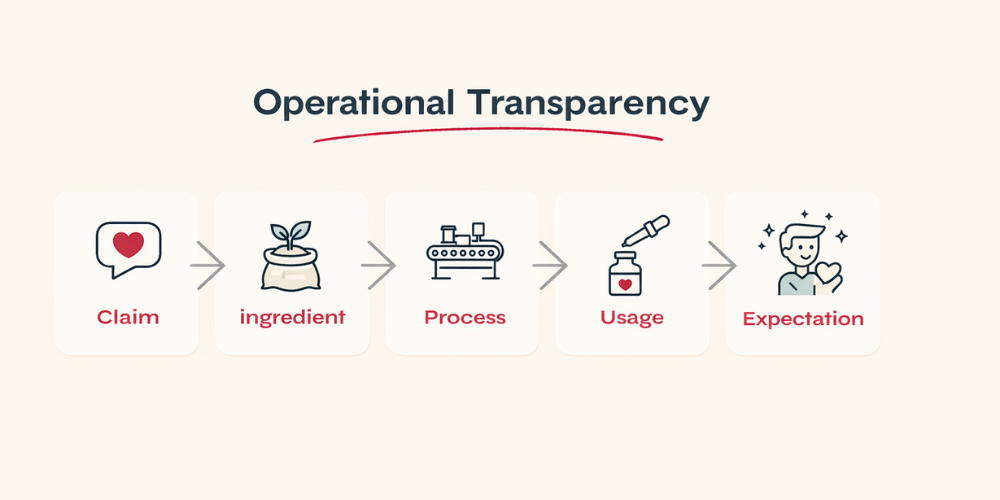
Operational transparency means a customer can trace a clean line from:
claim → ingredient → process → usage → expectation
In practice, transparency shows up in very practical ways:
- Pattern Wellness keeps product pages clear and skimmable, with straightforward labeling and transparent ingredient information that makes formula comparison easier.
- PupGrade separates active ingredients from functional soft-chew ingredients, so pet parents can quickly see what’s delivering support versus what makes the chew usable.
- Cosy House pairs material details with care guidance, because in home goods, transparency isn’t just what something is made of—it’s how it performs over time.
- And across all three brands, U.S.-based customer service supports customers seeking clarity on ingredients, materials, usage, or expectations.
Transparency fails when it’s decorative.
It works when it’s operationally consistent.
Pillar 2: Scientific Rigor
A Finished Formula Is One That Can Be Explained Honestly
One of the fastest ways to erode trust in wellness is to build a product first and figure out how to talk about it later.
Scientific rigor means reversing that instinct.
It asks:
- Why is this ingredient here?
- What does the evidence actually support?
- What can’t we say yet?
Scientific rigor isn’t a phase. It’s the workflow.
When we have a product idea—whether it’s for Pattern Wellness, PupGrade, Cosy House, Theonia, Hey Nutrition, or any brand in our portfolio—we start by pressure-testing the concept from multiple angles:
- Science first: What does the research actually support, and what’s mostly hype?
- Real-world fit: What do customers want in everyday life, and what will they realistically use consistently?
- Formula scrutiny: Dosage logic, ingredient selection, and functional features are reviewed, then reviewed again.
- Cross-checks with partners: We validate details with suppliers, manufacturers, and relevant experts—especially when ingredients, flavors, formats, or product performance are involved.
- Post-build verification: Even after a product is built, we revisit the research and internal documentation to confirm that the product story still matches the facts.
That’s why our education and claims are built to stay inside what we can support—not just what sounds compelling at launch.
Pillar 3: Human-First Design
Real Life Is the Real Use Case
Wellness products don’t live in ideal routines. They live in missed days, rushed mornings, inconsistent schedules, picky pets, and laundry cycles.
Human-first design starts by accepting that reality—and designing around it.
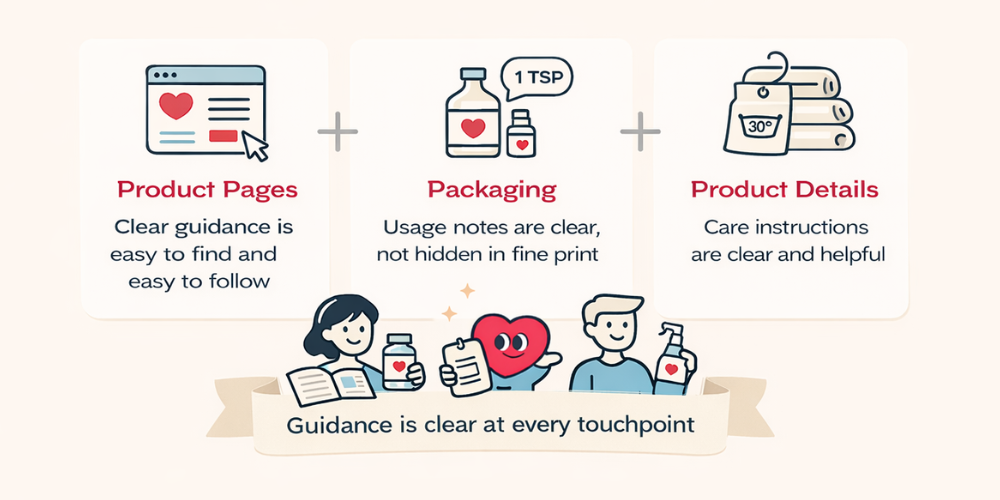
This thinking shows up long before a product reaches a shelf or a customer’s home. It influences not just the product itself, but how information is presented, repeated, and reinforced across every touchpoint.
That includes:
- Product pages and education, where guidance is written to be easy to find and easy to follow.
- Packaging and label design, where serving sizes, care instructions, and usage notes are laid out clearly rather than buried in fine print.
- Physical product details, like wash labels or back-of-pack guidance, where clarity matters just as much as aesthetics.
Across our brands, that looks like:
- Pattern Wellness prioritizing clear usage guidance on labels and product pages, supported by customer service when questions come up.
- PupGrade repeating serving guidance in the places pet parents naturally look, reducing uncertainty that can disrupt daily routines.
- Cosy House treating care instructions as part of the product experience itself, because how something is washed and maintained directly affects performance and trust.
Human-first design isn’t about perfection.
It’s about making the right behavior easier than the wrong one—on day one and long after.
Pillar 4: Responsible Sourcing
Sourcing Determines What Happens When Something Goes Wrong
Sourcing is often framed as an ethical decision. In practice, it’s a reliability one.
Suppliers determine:
- Whether batches stay consistent
- How traceable an issue is
- How quickly a team can respond if something needs clarification
Responsible sourcing means choosing partners who support long-term accountability rather than short-term availability.
- Pattern Wellness prioritizes responsible suppliers that can provide thorough documentation and consistency as volume scales up.
- PupGrade applies food-safety discipline to pet products, where traceability and allergen clarity directly affect customer trust.
- Cosy House validates durability before scaling production, because a supplier that looks good on paper can still fail in the real world.
Customers may never see the supply chain.
But they feel its impact immediately.
Pillar 5: Cross-Category Thinking
Standards Should Travel Across the Business
Cross-category thinking means we don’t treat each brand, market, or product type as a standalone system. Instead, standards, learnings, and guardrails move across the business—whether we’re working in human wellness, pet wellness, home essentials, or global markets.
That shows up in ways such as:
- Product and research standards are shared across brands, so insights gained during formulation, sourcing, testing, or manufacturing inform future decisions everywhere—not just within one product line.
- Customer behavior insights travel too. What we learn about how people actually use products in daily life influences how we design instructions, packaging, education, and features across categories and regions.
- Global compliance and claims work play a major role. For UK and EU brands, such as Theonia, health claims are subject to stricter regulatory frameworks, which means products, labels, and education go through extensive audits to ensure alignment with regional requirements. Those learnings don’t stay siloed—they inform how we approach claims language, substantiation, and risk management across other brands and markets as well.
- Safety and documentation expectations remain consistent regardless of geography, so clarity and accountability don’t change from one brand or region to another.
This doesn’t mean every product looks the same or follows identical rules.
It means the standard stays consistent, even when the requirements change.
Cross-category thinking isn’t about expanding product lines or copying formulas.
It’s about building smarter, globally informed systems that hold up as the business grows.
Pillar 6: Speed With Guardrails
Moving Fast Only Works When Structure Is Already in Place
Speed without structure creates invisible costs.
It leads to:
- Confusing education
- Avoidable reformulations
- Customer support overload
- Trust erosion that’s hard to reverse
Speed is earned through preparation.
- Pattern Wellness validates testing, claims, and education before launch to prevent confusion afterward.
- PupGrade runs soft chew and flavor testing before full rollout, because a product dogs won’t eat isn’t a minor issue—it’s a total failure.
- Cosy House evaluates wash durability before scale, preventing one of the most expensive home goods mistakes: shipping something that degrades after a few cycles.
Fast only works when guardrails are in place first.
Pillar 7: Operational Integrity
The Brand Is What Happens After Checkout
Operational integrity isn’t flashy, but customers feel it immediately.
It shows up in the moments that matter most:
- Products arriving as expected
- Education matching real-world use
- Support teams giving clear, confident answers
- Issues addressed with transparency rather than deflection
At Wholesome Goods, integrity means the work doesn’t stop once a product ships. In many ways, that’s when it begins.
Across all of our brands, customer service plays a central role in maintaining that standard. In December 2025 alone, our team handled:
- 232,062 customer emails
- 39,264 live chats
- 11,218 phone calls
- With an overall customer satisfaction rating of 4.44
Those numbers aren’t just volume—they reflect how often customers reach out with real questions about ingredients, formulas, materials, usage, care, subscriptions, and expectations. Operational integrity means being equipped to answer those questions accurately and consistently, every time.
That responsibility shows up in different ways across the business:
- Education doesn’t freeze at launch. When customers ask the same questions repeatedly, product education is reviewed and refined to reduce confusion going forward.
- Documentation enables clarity. Batch records, lot traceability, and internal documentation allow teams to resolve issues precisely rather than relying on generic responses.
- Flexibility is built into long-term use. Subscribe & Save options are designed to be adjustable, so customers can pause, change, or update deliveries as their needs evolve.
- Feedback loops stay active. Follow-ups, reviews, and surveys help surface real-world experiences that inform product improvements and future decisions.
Operational integrity isn’t about never making mistakes.
It’s about owning the full lifecycle—from first impression to long-term use.
Trust isn’t built at launch.
It’s built through follow-through.
Modern Wellness Is Built, Not Branded
The wellness companies that last aren’t the loudest.
They’re the most structurally sound.
They:
- Build trust into systems instead of slogans
- Make decisions they can stand behind months later
- Treat wellness as a responsibility, not a shortcut
These seven pillars guide how we build and scale across wellness, home, and pet—so what we put into the world holds up in real life, not just on launch day.
If you want wellness, you can verify, not just believe—this is the blueprint.
If this framework resonates with you:
- Follow Wholesome Goods on LinkedIn for behind-the-scenes product thinking
- Explore our family of brands to see these pillars in action
- Interested in building systems, not just stories? Visit our Careers page
Resources:
- Grand View Research. (2025). U.S. dietary supplements market size | Industry report, 2033. Grand View Research. https://www.grandviewresearch.com/industry-analysis/us-dietary-supplements
- Council for Responsible Nutrition. (2024, October 29). CRN survey shows consistent supplement usage with increase of specialty product use over time. Council for Responsible Nutrition. https://www.crnusa.org/newsroom/crn-survey